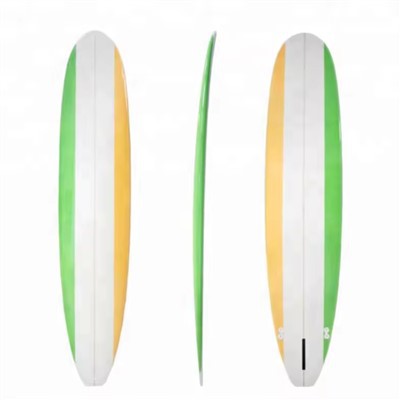
Nose
The EPS Surfboards nose is the very tip of your board. Typically a pointed nose, or rounded depending on your board's shape. This is where your rocker points to assists in direction.
Stringer
The stringer is the reflection point, running from nose to tail down the center of your board. This is where your EPS Surfboards parallel aspect changes course.
Rocker
The rocker is one of the most important design features to a EPS Surfboards. It’s the vertical curvature from the boards tail, right through to the nose. Used as either a heavy or relaxed format. Heavy being steeply curved and relaxed being only a slight curve. The nose rocker or flip is the curved section between them from the tip and the middle, or the flattest portion of your board. The tail rocker or otherwise known as the kick is the space between the tail and the middle flattest portion.
Concaves
Surfboards are made up of multiple different contours on the bottom, top, and side. The bottom is known as a concave. The concave on most modern surfboards begin about twelve inches or roughly 300mm. The purpose of a concave is to direct the water, typically directing them through to the fins. This can drastically impact drive, and stability which will impact maneuverability.
Leash
The leash, or otherwise known as a leg rope was invented to prevent unnecessary swimming, safety, and convenience. It’s never ideal coming off your EPS Surfboards and collecting it from the beach.
Leash Plug
The leash plug came along with the Leash, Found at the back end of the board, the simple pre fiberglass addon is very basic. It allows for connecting and disconnecting your leash. Leash plugs are put in via the board shaper and come in pretty much any colour. Your choice when choosing a board is normally limited, and most boards come with a black or a white plug.
Fins
If you have ever ridden a EPS Surfboards without fins, you would know how important they’re. The fins control speed, thrust, turns, and so much more. Not only getting the correct fin set, whether it be single, twin fins, thrusters, quads or even five fin setup. This is called your configuration. Alongside your configuration. You have your type, size, and shape.
Fin Plugs
As the name suggests, the plugs where the fins are located. These need to be precision and put in the right place to allow correct water flow.
Tail
EPS Surfboards tails drastically impact your board's response. Tail shapes varty from pin tails, to square, squash and swallow. Each tail has its own advantages and disadvantages. These range from speed, control, and maneuverability.
Rail
The rails are the edge or your board, the curved radius around the board which divides top, and bottom. Surfboard rails come in either soft or hard. The difference being more round for soft, and more squared for hard.
Bottom
As the name would suggest, this is the bottom of any surfboard. The surface in which connects with the water, the underside of your desk. The bottom of your EPS Surfboards is important due to the fact it controls the waters flow and channels it correctly. Boards come with a concave, and sometimes with a convex.
Outline
Your EPS Surfboards outline is the overall shape, the radius around your board or known as the “template”. This is the very first and most important part of your board and defines the type of board.
Traction Pad
Although we haven’t counted the traction pad as a EPS Surfboards part, it’s still important to mention. A traction pad is used in replacement of wax. It’s not a part that’s required, more desired. Offering greater support and grip on the back foot.